


Ten years ago, Stornoway Diamond spent about C$900 million building the Renard mine in Quebec’s James Bay region: a 2.2-million-ton-a-year processing plant, a 16-megawatt gas power plant, a 330-person camp, an airport, and a permitted tailings facility. The diamonds didn’t pay. The mine went into receivership, and the creditors were, in CEO Francis MacDonald’s words, “ready to rip this down.”
Li-FT Power optioned the whole thing in July for $12 million.
It works because a diamond plant and a lithium plant are nearly the same machine. Both crush rock and separate the heavy minerals from the light ones in a dense slurry. Swap one crusher type for another, add a second separation stage and a magnet, and Renard becomes a lithium concentrator 70 kilometers down the road from Li-FT’s Adina deposit. Rebuilding it today would cost “at least one and a half billion Canadian,” MacDonald said. The retrofit, the road, and the mine itself come to about US$260 million in the existing study.
Doug’s verdict in the debrief: “Four years is a long time until production, but with all the points that we heard and that you guys made, this is worth the speculation. I’m very interested.”
The stock trades around $1.47. EB Tucker: “Buck 50, I mean, why not?”
The deposit
Adina is 76 million tons at 1.15% lithium oxide, the third-largest hard rock lithium resource held by any development company in the world, per MacDonald. It sits at surface, flat, about 150 meters wide and 100 meters deep, with no lake on top. For the first six years the pit runs about 1.5% lithia and moves roughly one ton of waste for every ton of ore.
For the gold people on the call, MacDonald translated: 1.5% lithia at today’s prices is about 2.5 grams per ton gold equivalent, open pit.
The rock is simple: spodumene in white pegmatite, black host rock around it. Separation tests have run 72 to 82% recovery in the lab and 77% on a couple of tons through a dense media circuit, toward a standard 5.5% concentrate.
The 2024 scoping study, done by Winsome Resources before Li-FT acquired it, could only put 36 million tons in the pit because a claim boundary ran through the deposit. Li-FT bought the company on one side and a 75% interest in the other, from Azimut Exploration and the Quebec government. Even on the smaller pit, that study showed about US$1 billion in post-tax net present value, a 43% return, payback in under two years, and all-in costs near US$700 a ton at $1,500 spodumene. An updated resource and economic study with the full pit and this summer’s 45 infill holes is due in early Q1. The company then skips prefeasibility and goes straight to a definitive feasibility study by the end of 2027, with first production targeted for 2030.
On MacDonald’s capital intensity chart, Adina costs about $1,000 of capex per ton of annual concentrate, far below the other North American developers. “Brazil capital intensity, but sitting in a tier one jurisdiction like Quebec.”
The people
MacDonald spent ten years at Newmont doing greenfields exploration in Canada and Africa, then co-founded Kenorland Minerals, which made a three-million-ounce, six-gram discovery in Quebec with Sumitomo and still holds a 4% royalty on it. Li-FT was spun out of Kenorland.
Executive chairman Anthony Tse ran Galaxy Resources when it merged with Orocobre to form Allkem, then the fifth-largest lithium producer in the world, which became Arcadium and was bought by Rio Tinto for about $7 billion. Gary Bohm: “Somebody who’s achieved something of that magnitude doesn’t seem like they would have their name on a project that is a low probability of success.” Brent Cook: “They’re proper players.”
COO Jeff Ryneson was VP of operations at the Ekati diamond mine. Dominic Frisby added director Alex Langer of Sierra Madre Gold & Silver, who has put former First Majestic mines in Mexico back into production: “I just don’t believe he’d be on that board if these weren’t proper players.”
The largest shareholder is Agnico Eagle, through its critical minerals vehicle Avenir Minerals, which has invested $35 to $40 million over two years. Three brokers cover the stock with targets between $11 and $13.
What the panel said
John Hunt: “One of the smoothest... it was wonderfully done in my view.” Mickey Fulp: “You’ve done your homework, I’ll give you that.” Byron King, on the plant video: “It’s the cleanest plant I’ve seen in a while.” Doug: “Excellent presentation. Very impressive, actually.”
EB Tucker: “Totally professional. Francis is, like, you don’t bet against him on merit.” He overlaid spodumene futures on the stock chart: “When it went to 6,000 is when he went to 16 bucks... then it went to 3,000. His stock went to nine bucks. So the point is, you can get the stock for $1.47, $1.50, which is significantly cheaper than where they did that equity financing in August. It was, like, 2.90. If it does move again, the stock will move.”
Brien Lundin: “It is a play on spodumene, but it’s also a play on the business model, and the business model looks very sound. Management looks very good. So even if you miss on the lithium play, which I don’t, you’re at the bottom, it seems to be, of that cycle, and their numbers work at lithium prices lower than where they are now.”
Steve Hyland: “Everything you’ve assembled here really shows that you’re taking a pretty big swing.”
My own take: one of the more squared-away presenters we’ve had, in the deck and in how he handled questions.
Where the panel pushed
Metallurgy. Brent Cook couldn’t find the test work on the website proving the circuit reaches a saleable grade, and said so twice. MacDonald cited 11 metallurgical holes, three rounds of testing, and the 77% recovery, and promised to follow up. Brent afterward: “I am not comfortable with the metallurgical story.” A gap the company should close before the updated study.
Logistics. Concentrate travels 400 kilometers by all-weather road from Renard to the railhead at Chibougamau, then by rail to a port at Saguenay or Quebec City. Brent: “That’s an expense as well.” The 70-kilometer road from Renard up to Adina is being built with a Cree development corporation as proponent, with $13.5 million of federal money already funding its feasibility study, and MacDonald expects to finance it through a federal program that lets Indigenous groups borrow at the Government of Canada’s rate. Stornoway built 100 kilometers, including a major river crossing, in a year.
Cash. Li-FT has about $10 million. Keeping Renard on care and maintenance costs $18 million a year, mostly liquefied natural gas and a certified power-plant crew, with the next payment due around July 1. MacDonald expects to fund about $50 million of that before reaching project finance. The treasury gets the company through the Q1 study, then it will likely raise. The build itself would mix equity, debt, a strategic investor, and a prepayment from a battery maker or trader that wants the lithium. Brent: “They are gonna need more money pretty damn soon.”
Insider ownership. Gary Bohm asked why management holds only about 2%. MacDonald’s answer: the share count doubled from 47 million to 94 million in the Winsome deal, and he personally has bought in every financing and in the market at a cost basis around 80 cents. “I put in a decent amount of money at a buck 70 as well.”
The chart. Brent asked it bluntly: “What the hell happened from 9.10 to a buck 40?” The stock listed near $2.50 in 2022, ran to $16, fell to $1.40, ran to $9 last January on the spodumene spike, and is back at $1.40. MacDonald: “If you place us on top of the lithium price chart, you’ll see just as much volatility.” The Winsome deal also handed Australian shareholders a liquidity event, and they took it. Then: “There’s gonna be another cycle around the corner where Li-FT is probably gonna be a $9 stock again.”
The trade
Dominic Frisby: “The risk reward is pretty good below $1.50.” He expects tax-loss selling through December from holders underwater since January. “You’ve got between now and the end of December to buy it, and then flip it as the lithium price rebounds next year before they need to raise some more money. I’m putting together a note of tax-loss opportunities, and this is the top name on the list so far.”
MacDonald’s macro case: demand grew about 30% this year, CATL sees 20 to 30% annual growth through 2030, and doubling the market from here means “30 to 40 mines that have to come online.” He thinks the current weakness is Chinese buyers pushing futures down ahead of contract talks, as they do most years, and that “it’s gonna turn here in the next couple months.” Asked what keeps him up at night, he named the lithium market, not the project.
Key numbers
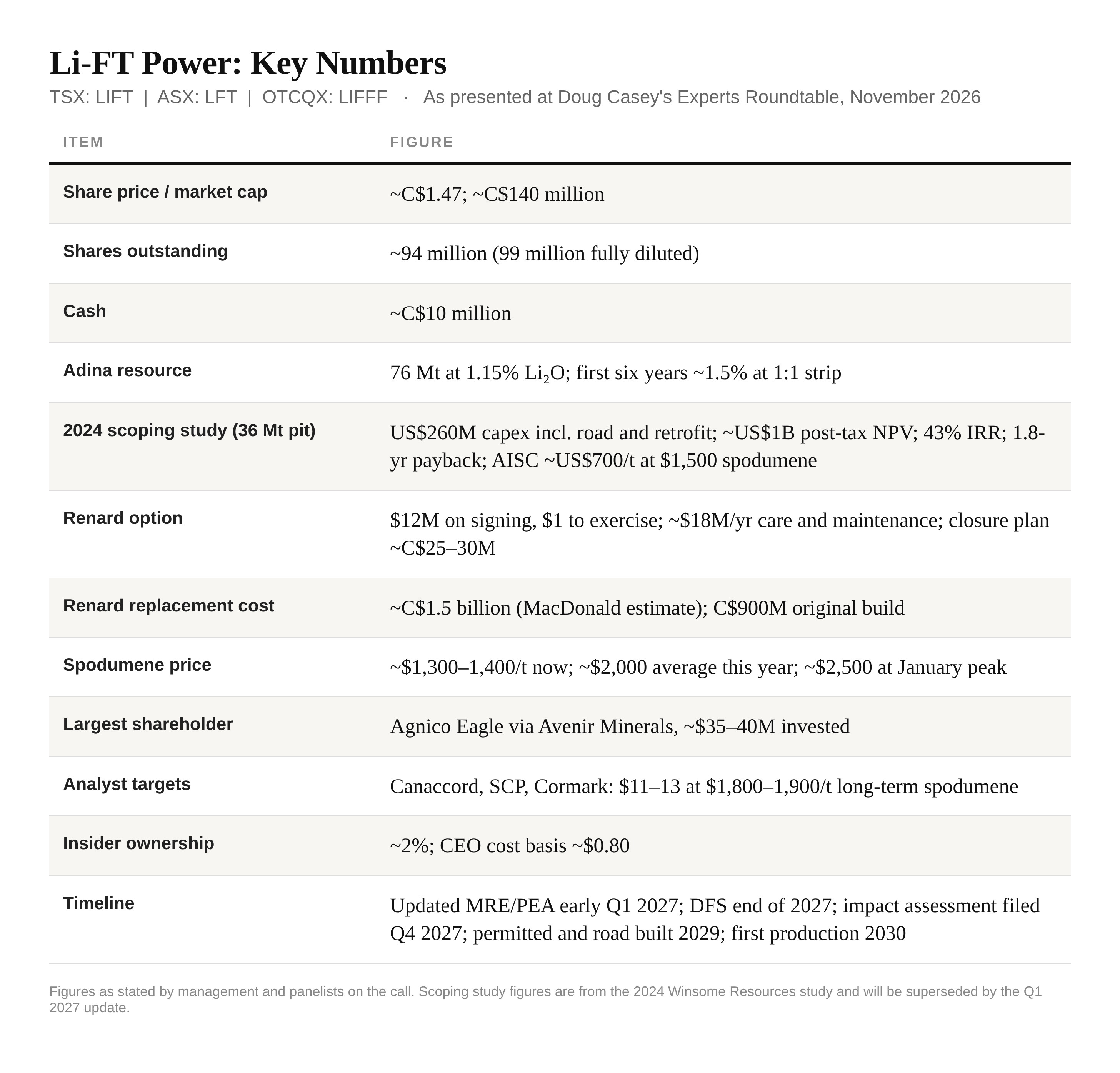
Company website:
Disclaimer: Li-FT Power paid a fee to present at the Experts Roundtable. This video is for informational and entertainment purposes only and is not investment advice. Junior mining stocks are speculative and volatile; you can lose your entire investment. Do your own due diligence and consult a licensed financial advisor before making any investment decision.


