


Doug Casey paid $1.10 a share for Arizona Eagle Mining in the private placement, with a half warrant at $1.50. It closed at 70 cents on October 6. He hasn’t sold a share, and Dominic Frisby’s reaction on the call was “I’m jealous of you, Doug, ‘cause I would have done that placement if I’d known about it.”
Doug’s own explanation, at the close of the session: “I’m not averse to taking a loss or cutting my losses as it were. But in this case, I didn’t. I buy the potential, I buy the story. So I don’t like sitting on a loss, but I don’t think it’ll stay there for long. I’m kind of a happy camper, frankly, all things considered.”
Doug is not one to sit patiently on a loser. So when he holds a down position through a bad stretch in the juniors and tells the panel he’d point new readers back to the company’s original pitch, that is worth more than a dozen bullish analyst notes. Anyone who missed the placement can now buy the same story for less than he did.
What changed since the company’s first appearance in April suggests he was right to stay put.
CEO Kevin Reid has found a way to drill the McCabe mine from inside the old workings rather than from surface, cutting the cost of 60 holes from $9.6 million to about $200,000, roughly three cents on the dollar. Here is the asset Doug is holding, and the pivot that makes it worth holding.
What Arizona Eagle owns
The McCabe mine sits on patented private ground in Yavapai County, Arizona, off a paved highway, with power and water nearby and under two hours from the Phoenix airport. It was a high-grade gold and silver producer that closed in the early 1990s at $300 gold, not because the ore ran out. CEO Kevin Reid: “They were underfunded. They didn’t have any capital.” The operators were bought by Magma Copper, which was bought by BHP at the top of the copper market, and BHP shut the mine to go build Escondida. A geologist bought it for $100,000. Arizona Eagle spent three to four years negotiating to get it, then another $6 million or so assembling the surrounding ground, including three past-producing high-grade silver mines. Twelve past-producing mines in all.
The historic estimate is about 880,000 ounces of gold at a recovered grade of 11.7 grams per ton, with 69 grams silver, calculated at a 6.8 gram cutoff in 1984. Reid’s point about that cutoff: at today’s one-to-two-gram cutoffs, “the width, the dimension in the width direction, is about a half to a third of what we think it could be.” Hole two from this year’s surface program supports it. The historic mining zone came in at about a meter of 10 to 11 grams, but the full intercept was five meters at 5.5 grams. Same gold, wider envelope.
The infrastructure is the other half of the story. A 14-foot concrete-lined production shaft, originally thought to go to 1,450 feet, which a submersible camera this summer showed goes to 1,650. About five kilometers of underground workings. A ventilation raise about 1,100 feet from the main shaft. Reid puts the replacement cost at around US$50 million and three years of work. At a C$35 million market cap, “I’m trading at almost a 50% discount to the cost of the shaft and the workings. So I’m not even getting paid for my infrastructure.”
The company drilled seven wildcat holes from surface this spring, deliberately avoiding the old workings so as not to lose holes. Two hit economic widths: hole two into what Reid believes is the faulted eastern extension of the McCabe system, and hole six into a separate, older volcanogenic massive sulfide system running nearly 30% zinc over a meter. “That is a 30% hit rate on economic widths. That is an incredibly positive outcome.”
The pivot: 60 holes for $200,000 instead of $9.6 million
This is the news, and Reid could barely contain himself delivering it. “I’ve only really recently learned this in the last 10, 12 days.”
Drilling from surface cost the company about C$420 a meter. Hitting 60 targets from surface means roughly 22,900 meters of drilling, eight and a half months, and $9.6 million. From underground, standing at the target instead of 1,500 feet above it, the same 60 holes need about 1,800 meters. The drill is smaller and cheaper, a $35,000 unit run by two men at $150 an hour. Total cost: about $200,000. Time: about a month.
“Our drilling cost goes down 95%, which means for a million dollars I could drill 300 holes. Three hundred holes would cost me $50 million from surface. It’s an absolute game changer for our company.”
Getting there means reopening the mine through the ventilation raise rather than the main shaft, using an Alimak climber instead of installing a $2 to $3 million hoist. Reid says that’s a quarter of the cost and half the crew. The contractor is Hancon Mining, whose client list includes Agnico Eagle, Americas Gold and Silver, and Pan American Silver, and whose CEO is taking the company’s margin in Arizona Eagle shares. The budget is US$3.7 million against C$5.5 million in the treasury. Engineering runs through January, groundbreaking in February, and Reid is guiding to drills turning underground in May or June, with the caveat that nobody knows the shape of the workings until they’re in them.
Dewatering takes about 10 days with a $150,000 to $200,000 pump. The first water sample from the ventilation raise came back, in the words of the consultant, better than Phoenix drinking water. Testing continues level by level.
Reid’s framing of the whole exercise: “I’m trying to give you as many lottery tickets as I can for the cheapest possible price.”
What the panel made of it
Byron King: “What’s really impressive is just sort of the serendipity of the whole situation... You’ve dramatically changed the house odds in this whole matter. A 97% drop of your internal cost to deliver meters of drill hole. A lot more holes for a lot less money, and that is how you find mineralization.”
Graham Summers asked for a comparable, and Reid offered Rob McEwen reopening the Dickinson mine at Red Lake in the early 1990s and drilling the high-grade zone: “That’s how I would, that would be my analogy. We’re going into a high-grade mesothermal gold system.”
Steve Hyland: “I quite like the strategy. The market likes seeing lots of drill holes. If Kevin actually executes on what he says he’s gonna do, it means that we’re gonna see lots of holes.” He also pushed back on Reid’s own modesty about not having met institutions yet: “Some of the names that he brought up, most juniors would actually call institutional names. He actually understands what real institutional investors are.”
Dominic Frisby, who had the hardest questions of the day, still closed on this: “I think he’s a heck of a competent individual. His management is aligned with shareholders, and I think he’s gonna make this work. And he’s a heck of a salesman as well.”
EB Tucker on the ownership: “The two Reid brothers have 30%, and then Mark Paris with another 15 and a half percent roughly. It’s pretty chunky. It’s not like people with nothing tied to this.” Reid, his brother, and the chairman have each put in about $2 million. Reid has added at least another half million since. Insiders have been buying in the open market over the past six weeks.
My own comment on the call stands: so much skin in the game is rare, and it’s the thing I weight most heavily here.
Where the panel pushed
Dominic Frisby raised the obvious one. In June the company said it had enough money to execute, the stock ran to $1.80 on the back of that session and some write-ups, and then came an upsized placement at $1.10 with warrants at $1.50. “Everyone who’s got stock at $1.80 just immediately dumps and comes in the placement.” Reid’s answer: he argued for taking less money, but the board, watching the GDXJ and larger peers drop 30 to 40% in months, decided to put the company on solid footing. “In hindsight, having the benefit of working with Hancon Mining and discovering a way that we can turn dollar costs into three-cent costs, and now we have the money to do that, I’m very grateful for our shareholders.” Those placement shares are coming free-trading now, and Frisby thinks the 4 to 5 million $1.50 warrants will cap the stock for a while in a name this illiquid.
Brian Leni questioned prioritization: why buy the silver mines and drill from surface before figuring out the underground? Reid’s answer is that the engineering, water testing, and contractor interviews took four months and he didn’t have the information in March 2025. “If I had known what I know now, I would’ve done that.”
Brent Cook, hearing the story for the first time, flagged the vein widths: the historic mining width was about a meter. Reid agreed that’s typical for these systems and said the mining method question is “way too early for me to opine on,” but pointed again to hole two’s five meters at 5.5 grams as evidence the envelope widens at a lower cutoff.
Lawrence Roulston pressed for a firm date on the first underground hole. Reid: May or June, “but I’m being told that it could be quicker, and I hope it is. It could be three times as quick, depending on the shape.” Cash lasts through the underground program at the full budget; a small raise before June is possible if it costs every dollar.
John Hunt made the point that once drilling costs collapse, assay costs stop being a rounding error. Reid: “Point taken.”
The setup
EB Tucker’s warning is also an opportunity. A stock that ran to $1.80 and came back to the 50s, with placement stock free-trading into November, is a textbook tax-loss selling candidate. “I would suspect that this thing hits pretty heavy tax-loss selling, second week of November for three weeks or something.” Then: “Which means you could get it cheaper. If you like the story at 65, 70, you might love it at 50.”
Dominic agreed. Brent Cook agreed: “This might be a great tax-loss opportunity.” Nobody on the call thought the plan was wrong. The debate was about when to buy, not whether.
Doug’s view on the broader backdrop: “I can’t help but count on a big bull market in these crappy little stocks. It’s been a long drought, and I think we’re coming up for another major bull market.” Dominic: “I share your optimism.”
The catalysts between now and summer are concrete: engineering complete in January, groundbreaking in February, dewatering, the shape of the workings, and then, if Reid delivers, a drill turning at the 830-foot level with 60 targets in front of it and a company that can afford to hit all of them.
Key numbers
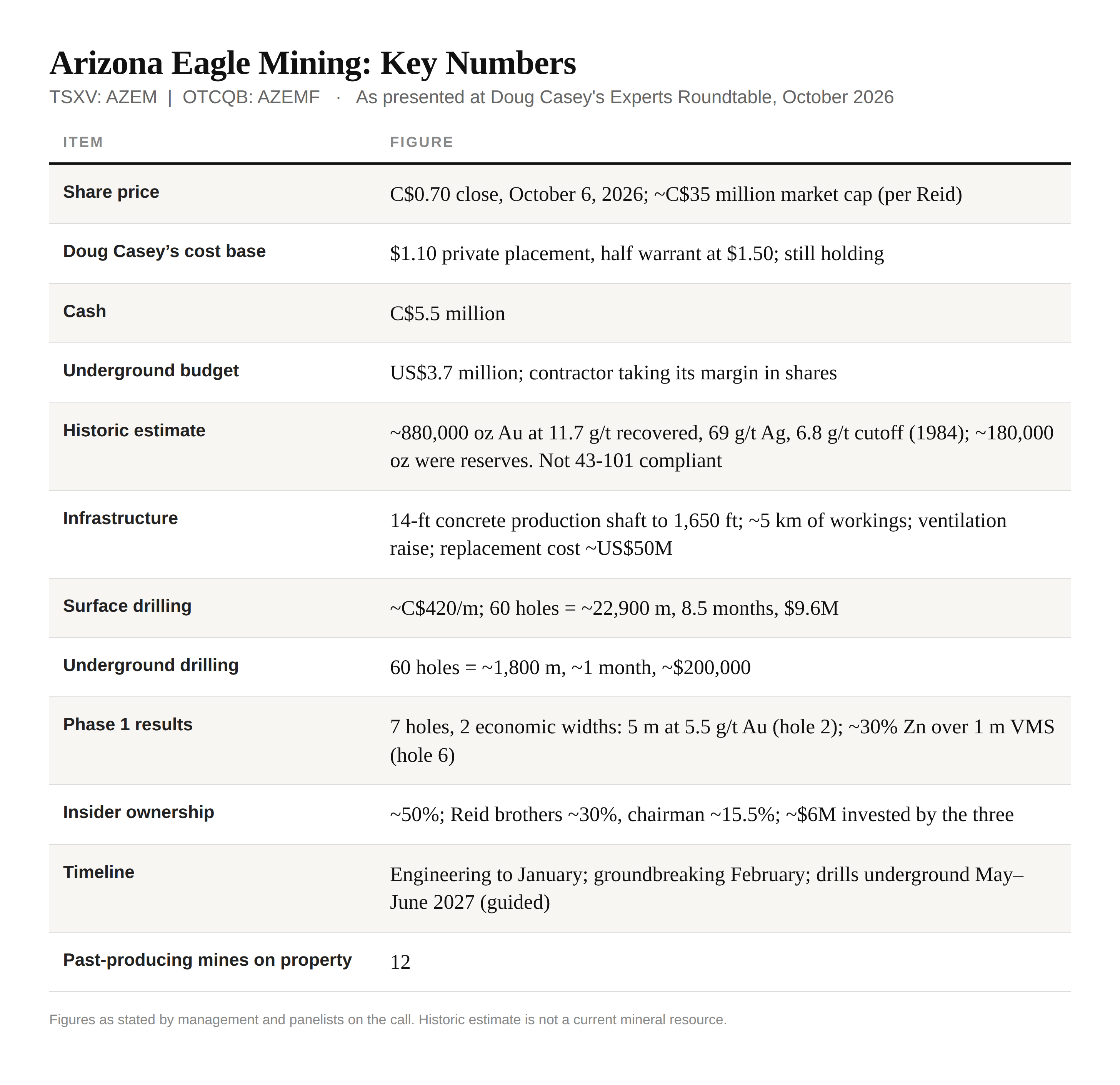
Company website: https://www.arizonaeaglemining.com
Disclosures: Arizona Eagle Mining paid a fee to present at the Experts Roundtable. Doug Casey stated he participated in the company’s private placement at $1.10 and continues to hold his shares. Dominic Frisby stated he bought shares after the company’s first appearance and continues to hold at a loss. Nothing here is investment advice. Quotes are lightly edited for readability.


