


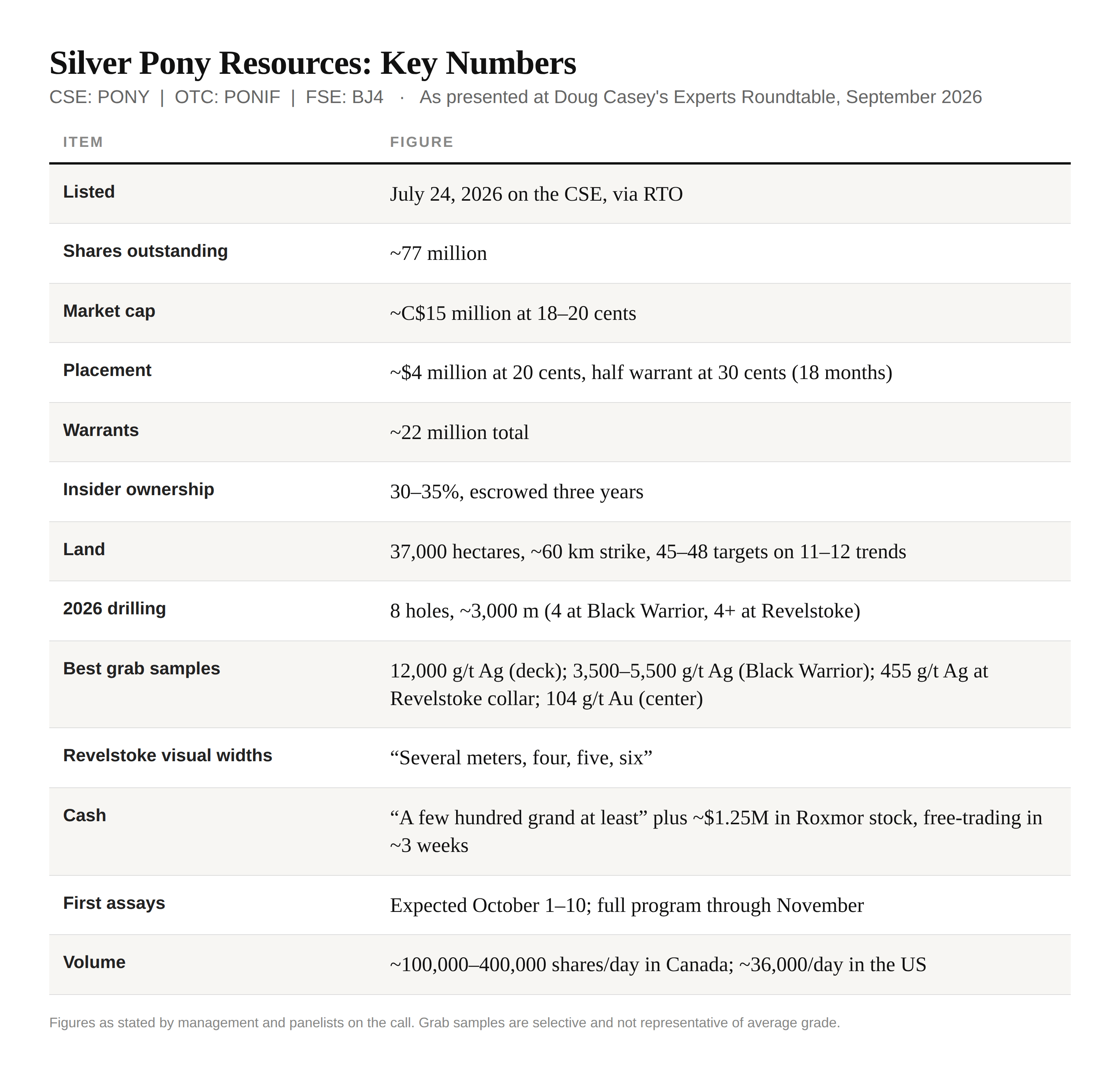
Silver Pony Resources is a C$15 million company that went public on July 24, holds 37,000 hectares of a silver district that produced by candlelight and donkey in the 1890s and has barely been touched since, and just finished its first drill program. The assays start landing in early October.
That is the whole setup, and the panel treated it as exactly what it is. Doug Casey: “It’s like a perfectly positioned drill hole play, and count me in if you’re gonna raise any more money.” Brien Lundin: “I’m tempted to buy the stock just on that basis.” EB Tucker: “This would be one that I would buy and roll the dice that they’re gonna release some goofy number of grams per ton.” Mickey Fulp, who had the sharpest criticisms of the day: “It’s probably worth a punt at 18 cents for these drill holes.”
Nobody called it a company to hold for five years. Several called it a stock they would buy for themselves in the next three weeks. Read on for why, and for what they’d want to see before it becomes more than that.
Watch the full session: [VIDEO LINK]
The ground
The property sits in the Lardeau district of southeastern BC near Trout Lake, an eight-hour drive east of Vancouver. Trout Lake was a boom town from the 1890s until World War I emptied it of miners. CEO Morgan Good’s explanation for the 60-year gap that followed: an oil and gas company acquired a huge block of southeastern BC claims for tax reasons and sat on them for over 65 years. “No junior mining company or any mining company could come in and take the claims.” When the ground opened up in the mid-2000s, a few small groups tried and failed to raise money. So the district went from pickaxes to essentially nothing.
What’s on it, per the company: a 60-kilometer strike length through the center of the package, 11 or 12 trends, 45 to 48 target areas, and grab samples that read like typos. Historic and recent samples of 3,500 to 5,500 grams per ton silver at the Black Warrior target, taken multiple times over multiple campaigns. A 1,600 gram-per-ton grab 40 meters from a drill pad. A 12,000 gram-per-ton sample in the deck. Gold samples of 104 grams per ton off an old adit in the center of the property. The Silver Cup mine next door, per exploration geologist Chris Furey, pulled out 21,000 tons at 1,500 grams per ton.
The model is a carbonate replacement deposit, or CRD: acidic fluids from an intrusion eat into limestone beds and replace them with sulfides. Furey’s description of drilling one: “When the drillers are telling me that the rods dropped six meters in a shift, at first they expected me to be quiet, but I was excited about that.” Lawrence Roulston, who knows the belt, called the carbonate trend “highly prospective, and I think not really appreciated.”
What they drilled
The company started drilling in June, before it was even trading. Four holes went into Black Warrior, where a 2011 program by Mineral Mountain had fanned holes outward from the top of the mineralized outcrop and hit only a meter of 47 grams. Furey’s approach was to drill through the fold instead: “They essentially just drilled into a couple of branches at the surface. We wanted to go after the trunks.”
Then the mapping teams found Revelstoke. Furey had four or five groups of geologists on the property competing to argue for their favorite target. “Once two teams went there, the rest of the teams wanted to go there.” He walked to where the drill was meant to go, cracked a rock, and “it opened up like something out of The Lord of the Rings.” The sample ran about 455 grams per ton silver. They moved the drill 18 kilometers over three mountain passes and collared into galena and pyrite at surface.
Holes five through eight, in the company’s own press releases, hit the same thing. Widths described as “several meters, four, five, six kinda meters.” Good relayed a call from advisor and prospector Kyler Hardy leaving site: “Have you seen the last nine meters in hole eight?” He left it there, since the rest is not yet public. Assays are expected between October 1 and 10, with the full program reported through November.
Doug’s summary of the panel debrief: “He didn’t say what the core was, but it sounded like the core looked really good.”
The people and the money
Good is the promoter and doesn’t pretend otherwise. “I pick up the phone and I talk to 50-plus people a day.” He rolled his previous shell, Carlyle Commodities, back 20 to one after selling its Newton gold project to Roxmor Resources, and has personally bought over a million shares in the open market since listing. Management and insiders hold 30 to 35%, escrowed for three years, and put about $500,000 into the $4 million placement.
Furey, 40, came from Teck’s exploration department, where he sat on the team that costed and risked projects before they were greenlit. He was the panel’s favorite. Doug: “I’m really impressed at how you’re working with what you have.” EB Tucker: “Five stars for Chris. He also is a pretty chill guy, so he gives you confidence that he’s got a plan.” Brien Lundin: “He didn’t sound promotional, but he was a damn good promoter.”
The financing story has one unusual feature. The Newton sale left Silver Pony with about $1.25 million in Roxmor stock that comes free-trading in roughly three weeks. Good’s point: a $15 million junior with a non-dilutive cash source to fall back on “is something that I don’t even know another one that’s got one.” Doug happens to own Roxmor himself: “I agree with everything you said about that, so congratulations.” The treasury otherwise has “a few hundred grand at least” after a program that was meant to be 5,000 meters and came in closer to 3,000 because heli-supported drilling through karst and faults got expensive.
Where the panel pushed
This is a drill-hole play, and the experts spent most of the session testing whether the drill holes were aimed well.
Brien Lundin opened it: typically a company would run soil surveys and geophysics before drilling. “But that said, if you did that, you wouldn’t be drilling for at least another season. And so I kinda like this, frankly. Low market cap, decent share structure, enough money to go drill, and you’re going to go drill.” Furey’s answer was candid: “I would’ve preferred a lot more mapping and geophysics,” but “my only objective this summer was to prove concept.” Asked by Steve Hyland what he’d have done with unlimited time, Furey said 100 mappers, a year of modeling, airborne and ground geophysics, then drill targets the year after.
Byron King and Ed Bugos both raised selection bias. King: “I can think of a whole lot of places where I’ve been where they’d have historical mining, where if I walk up to the tailings pile, I can find high-grade grab samples.” Bugos: “I don’t know how many times I’ve seen exploration programs where they have such incredible grab samples, and then the drill results don’t turn out that well.” His threshold for a real result is width: “If they get anything more than a meter with these kinds of grades, then they’re off and running.”
Mickey Fulp was the toughest. He asked whether any systematic chip-channel sampling had been done across the mineralized horizons rather than grab samples. Furey: “Nope. No, I don’t think so.” Fulp also questioned the plan to run induced polarization surveys, since CRDs are “notoriously unresponsive” to IP, and in the debrief said he “didn’t think he was very well prepared.” His conclusion anyway: a punt at 18 cents, “get in and get out.”
Dominic Frisby flagged the structure. Roughly 22 million warrants, about half at a low inherited strike and the rest at 30 cents, plus placement holders who paid 20 cents and are watching the stock trade at 12 to 18. “I think that will put something of a cap on things.” And the CSE listing means less capital than the Venture. “If it goes the wrong way, it’s gonna be quite a hard one to get out of.”
Frisby also asked the question that hung over the debrief: with drill results due in weeks, why the marketing push now, including this session, a German program, a US program, and a stable of YouTube channels? “Is that to bring attention to their drill holes or to compensate for them?” My own read, which I said on the call, is that a company planning this much follow-through is expecting good news. EB Tucker’s version: “Put it on your screen is what they want you to do, and then when they release something goofy, you see it go and you pile in.”
The trade
Every expert who said they’d buy also said they’d buy it as a trade, not a recommendation. Lundin: “It’s a play that I think I would buy but not necessarily recommend to my readers.” Frisby: “I’d buy it myself for a flip. I think I’d probably hang around for a good time rather than a long time.” King: “I’ll probably buy some shares just for me.”
The reasons are the same reasons it’s interesting. It is small, illiquid in the US, sitting at 18 cents with warrants overhead, and three weeks from a binary event. Tucker put the asymmetry plainly: “It’s still small, which matters.” John Hunt raised what comes after a good hole, the “valley of despair” of years more work in helicopter country, and Furey’s answer was that Trout Lake has a molybdenum mine with a mill and old mining roads he mountain-biked on. Fair, but that is a question for 2027.
For October, the question is whether the core that got Kyler Hardy excited on the phone assays the way it looks. Doug’s close: “Good story altogether. I’m very pleased.”
Company website:
https://silverponyresources.com
Disclosures: Silver Pony Resources paid a fee to present at the Experts Roundtable. Steve Hyland stated he is a shareholder through the predecessor company, Carlyle Commodities. Doug Casey stated he owns shares of Roxmore Resources, in which Silver Pony holds equity. Nothing here is investment advice. Quotes are lightly edited for readability.


